Introduction
Antoni Gaudí is often associated with some of the most recognisable buildings in the world. From the soaring towers of Sagrada Família to the colourful surfaces of Casa Batlló, his work continues to influence architects, artists, and designers nearly a century after his death. Yet while his built projects have been studied extensively, it is interesting to consider a different question: what might his architecture look like if it were applied to a completely different building type and context?
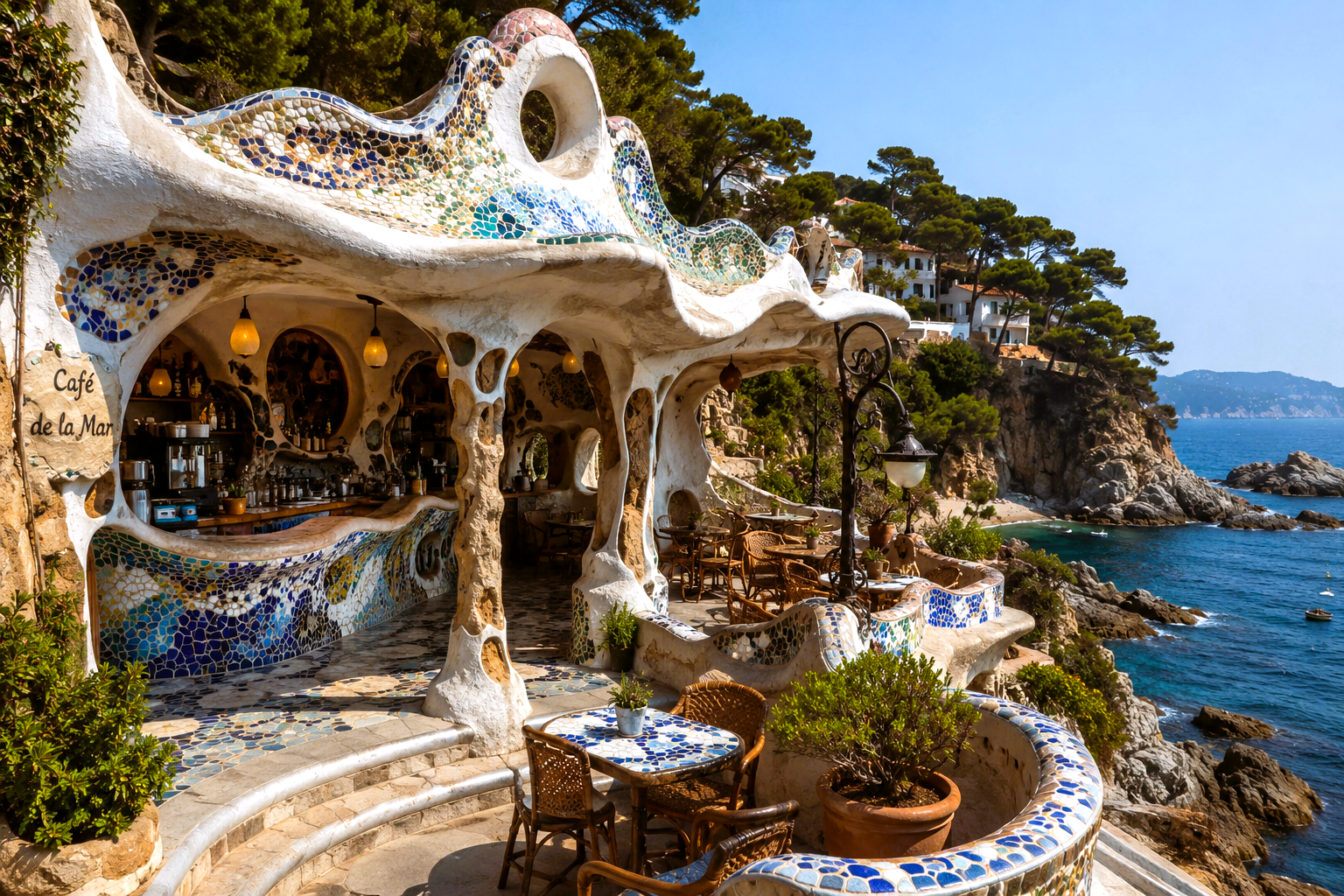
Recently, I found myself exploring this question through a simple thought experiment. What if Gaudí had been commissioned to design a small café overlooking the Costa Brava coastline? Not a cathedral. Not a museum. Not a public monument. Just a place where people could sit, drink coffee, and watch the Mediterranean.
The question may sound speculative, but it reveals something interesting about both architecture and contemporary technology. Today, we have access to tools capable of visualising ideas that were never built, allowing us to explore architectural possibilities that exist somewhere between history, imagination, and design.
Reinterpreting Gaudí Beyond Style
One of the biggest challenges in imagining a Gaudí café is avoiding the temptation to reduce his architecture to visual features. Curved forms, colourful mosaics, and organic geometry are often the first things people associate with his work, but these elements were outcomes of deeper ideas rather than the ideas themselves.
Gaudí’s architecture was heavily influenced by natural systems. Rock formations, trees, shells, caves, and the behaviour of light all played important roles in shaping his buildings. Rather than treating nature as decoration, he often treated it as a design methodology. Structure, material, geometry, and ornament were interconnected.
For this reason, a hypothetical café in Costa Brava should not look like a miniature Sagrada Família placed beside the sea. Instead, it should respond to the landscape in a way that feels consistent with Gaudí’s broader design philosophy. The rocky cliffs, Mediterranean vegetation, and dramatic coastal views already possess qualities that align naturally with many of the themes present in his work.
© Naveen Maria Fleming / ArchitectsWhoCode
Imagining the Café
The first image that emerged was not actually a building. It was a view.
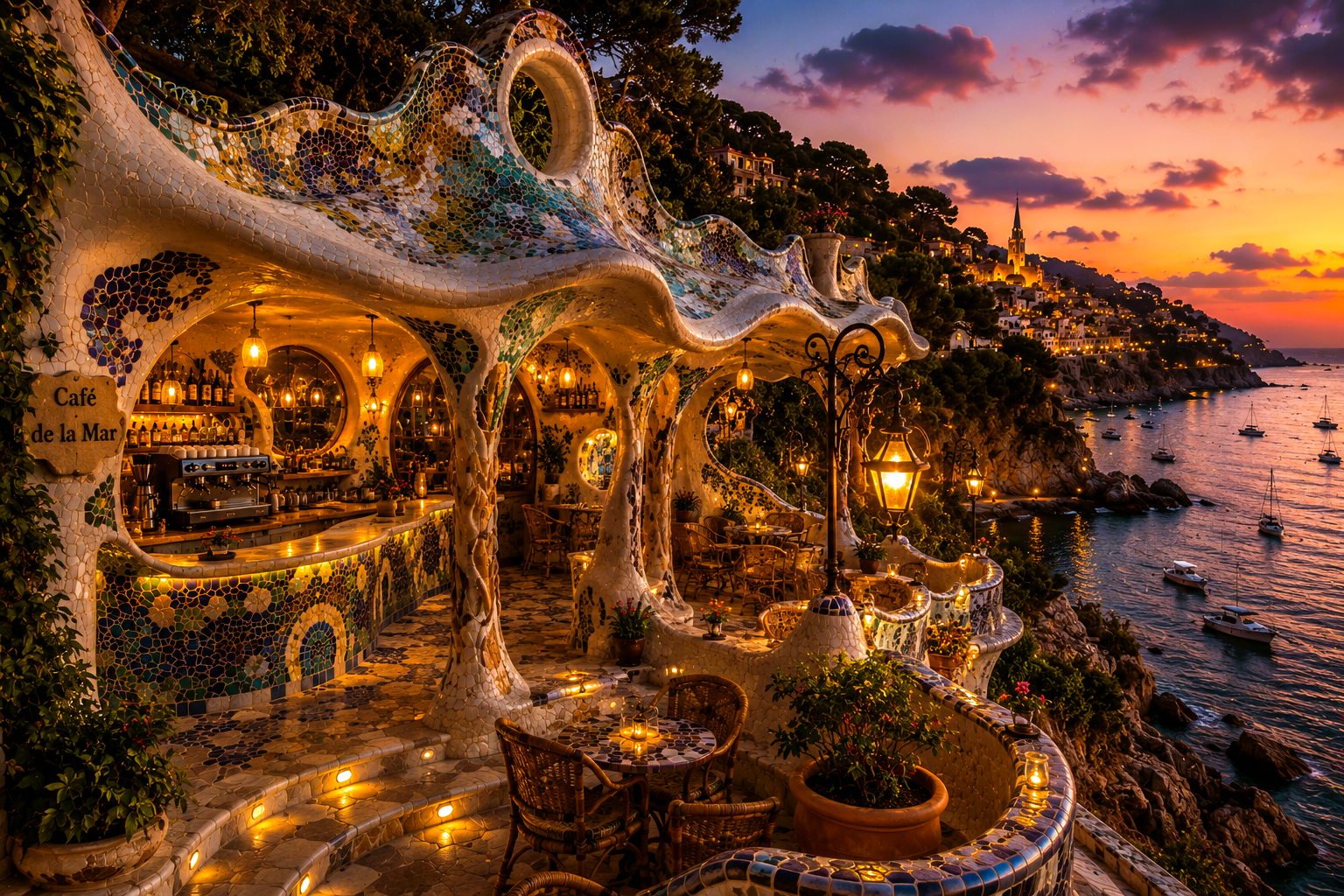
A terrace overlooking the sea during sunset. Warm light reflecting on mosaic surfaces. Curved openings framing the coastline. Small groups of people sitting near the edge of the cliff while the lights of the village begin to appear in the distance.
From there, the architecture began to develop.
The café gradually became a small building embedded into the terrain rather than an isolated object sitting on top of it. The roof adopted softer forms inspired by waves and coastal geology. Openings became carefully framed views rather than large uninterrupted glass walls. The terrace became an extension of the landscape itself.
What surprised me most was that the most convincing versions were often the least dramatic. Whenever the architecture became too large or too iconic, it immediately felt disconnected from the intimacy that makes cafés enjoyable. The strongest iterations felt personal rather than monumental.
© Naveen Maria Fleming / ArchitectsWhoCode
When Architecture Meets Hallucination
As the exploration progressed, another interesting observation emerged.
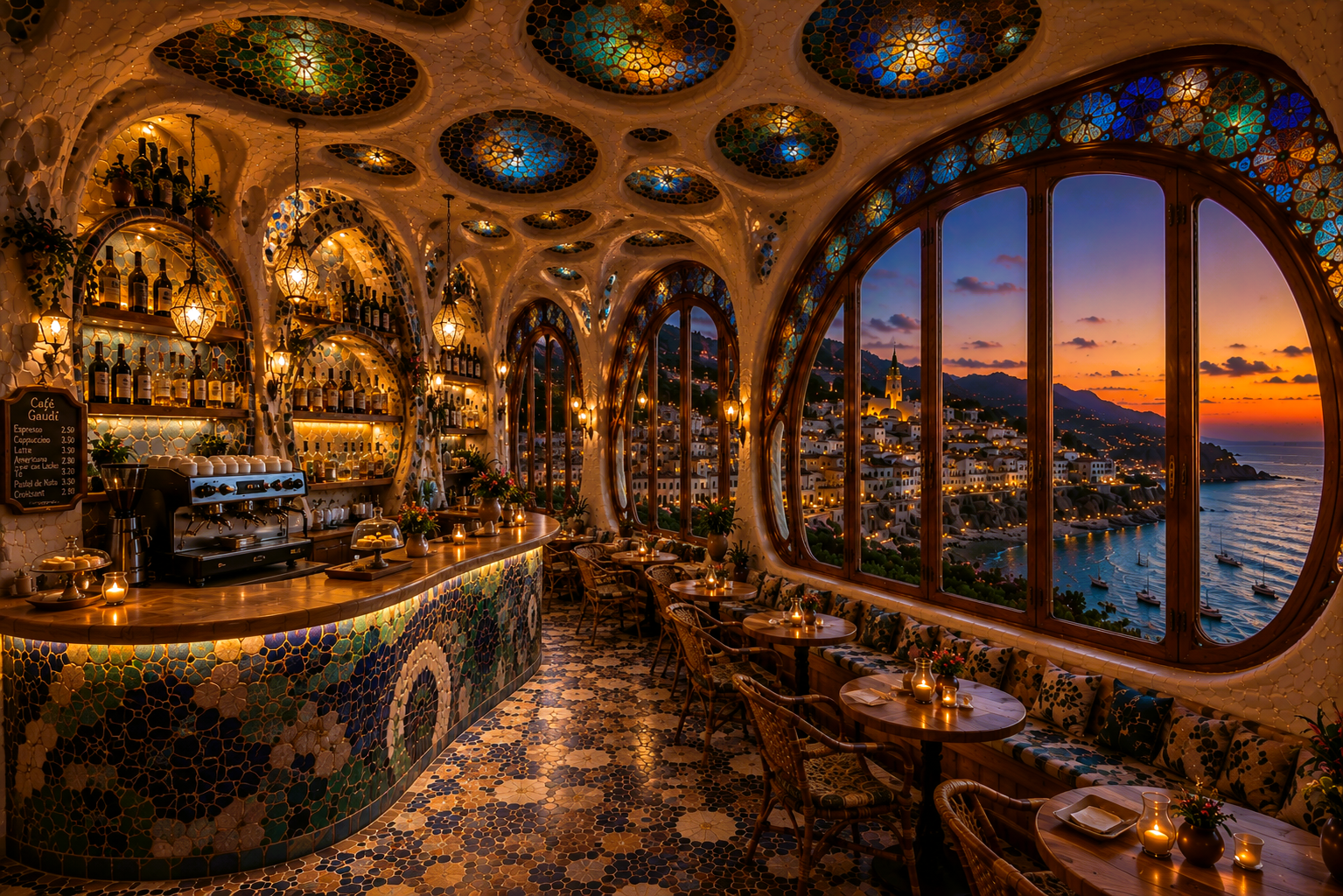
Many of the visualisations looked convincing at first glance but began to reveal inconsistencies when examined more closely. Interior spaces suggested one type of building while exterior views suggested another. Roofs did not always correspond to the spaces beneath them. Windows appeared beautiful from inside but raised questions about how they would actually function.
These moments highlighted an important distinction between imagination and architectural logic.
Technology can generate atmosphere remarkably well. It can produce mood, lighting, materiality, and visual character in a matter of seconds. However, architecture requires more than atmosphere. Buildings must maintain relationships between interior and exterior, structure and form, function and experience.
In several cases, the most useful outputs were not the successful ones but the flawed ones. A window detail that did not work prompted a better solution. An oversized roof revealed a problem with scale. A terrace arrangement suggested a stronger connection between architecture and landscape. The process became less about accepting images and more about evaluating them critically.
Conclusion
Perhaps the most interesting aspect of this exercise is that the café never existed and never will. There are no drawings hidden in an archive and no forgotten commission waiting to be discovered.
Yet the question remains valuable.
What if Gaudí had designed a café in Costa Brava?
There is no definitive answer, but exploring the possibility reveals something important. Technology can help visualise architectural ideas that history never had the chance to build. At the same time, it reminds us that imagination alone is not enough. Architecture still requires judgement, coherence, and an understanding of how spaces actually work.
In the end, the exercise was not really about recreating Gaudí. It was about using imagination to explore an architectural possibility and using architectural thinking to decide which parts of that possibility were worth keeping.