From visible elements to spatial interpretation
Introduction
Interior images are usually read in a very instinctive way. We look at a room and immediately understand more than what is physically visible. We notice where people might sit, where the visual focus lies, how the room is organized, and whether it feels formal, relaxed, dense, or open.
Object detection approaches the same image from a very different position. It does not begin with atmosphere, intention, or use. It begins with recognition.A sofa, a lamp, a table, a curtain, a rug. On its own, that may seem too simple. But that simplicity is what makes the method useful. By breaking an interior image into clear, recognizable elements, object detection gives the image a structure it would not otherwise have.
Object Detection and Interiors
The significance of this lies not in the novelty of detection itself, but in what can be built on top of it. Once visible elements are identified, grouped, and compared, an interior image begins to shift from visual reference to analytical material.
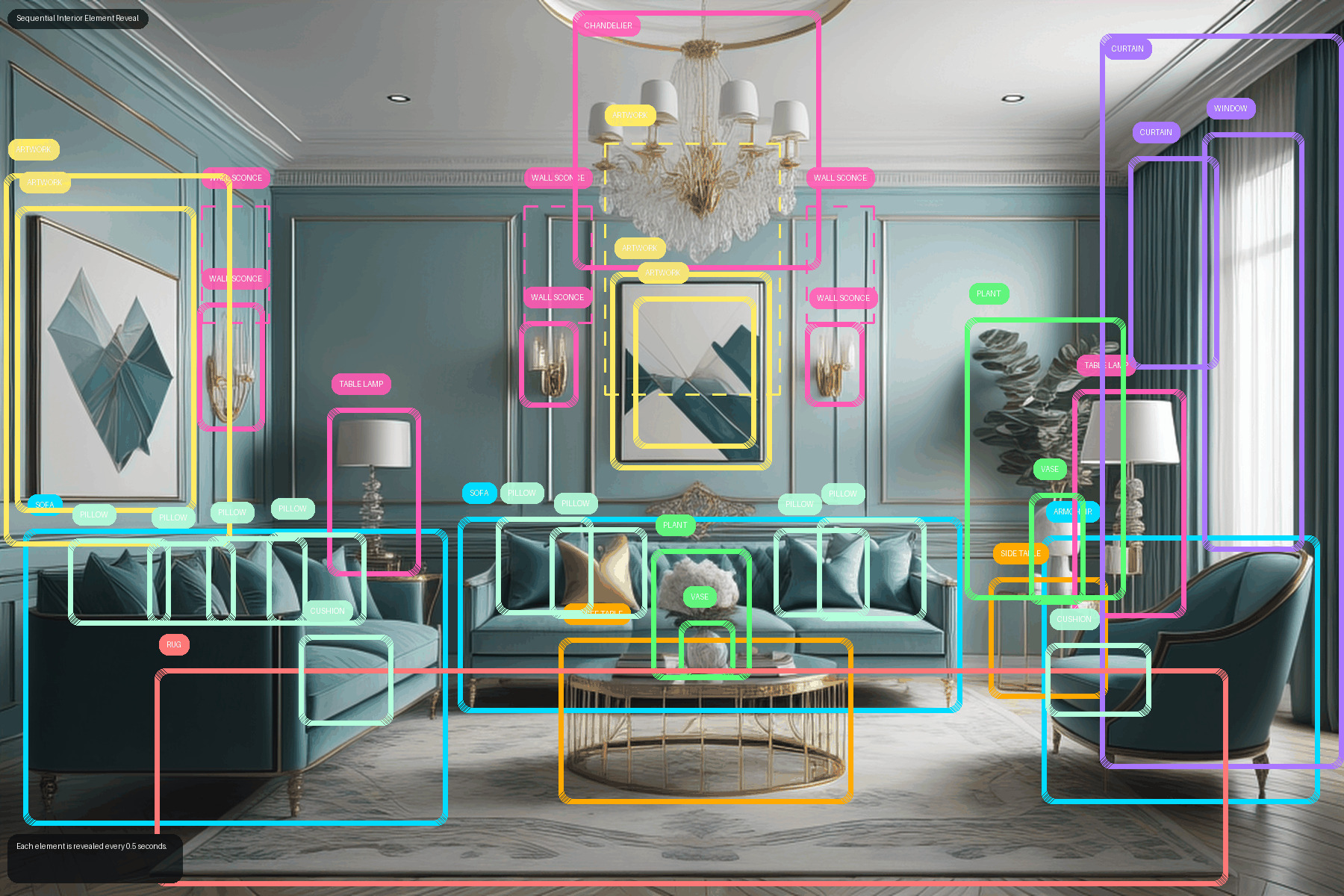
At a technical level, object detection identifies recognisable elements within an image and locates them spatially. In the case of interiors, these elements are often furniture, lighting components, decor, openings, or soft spatial markers such as rugs and curtains.
That first layer is relatively literal. It does not yet amount to interpretation. It simply establishes what is visibly present and where it appears in the frame. But that initial layer matters because it transforms the image into something more legible. Instead of being treated as an undivided scene, the room begins to separate into components.
This distinction is important. A room image that remains purely visual is difficult to compare, quantify, or structure. A room image that has been translated into detected elements can begin to support those operations.
From detected elements to spatial clues
The real value of object detection emerges only when the detections are no longer treated as isolated labels.
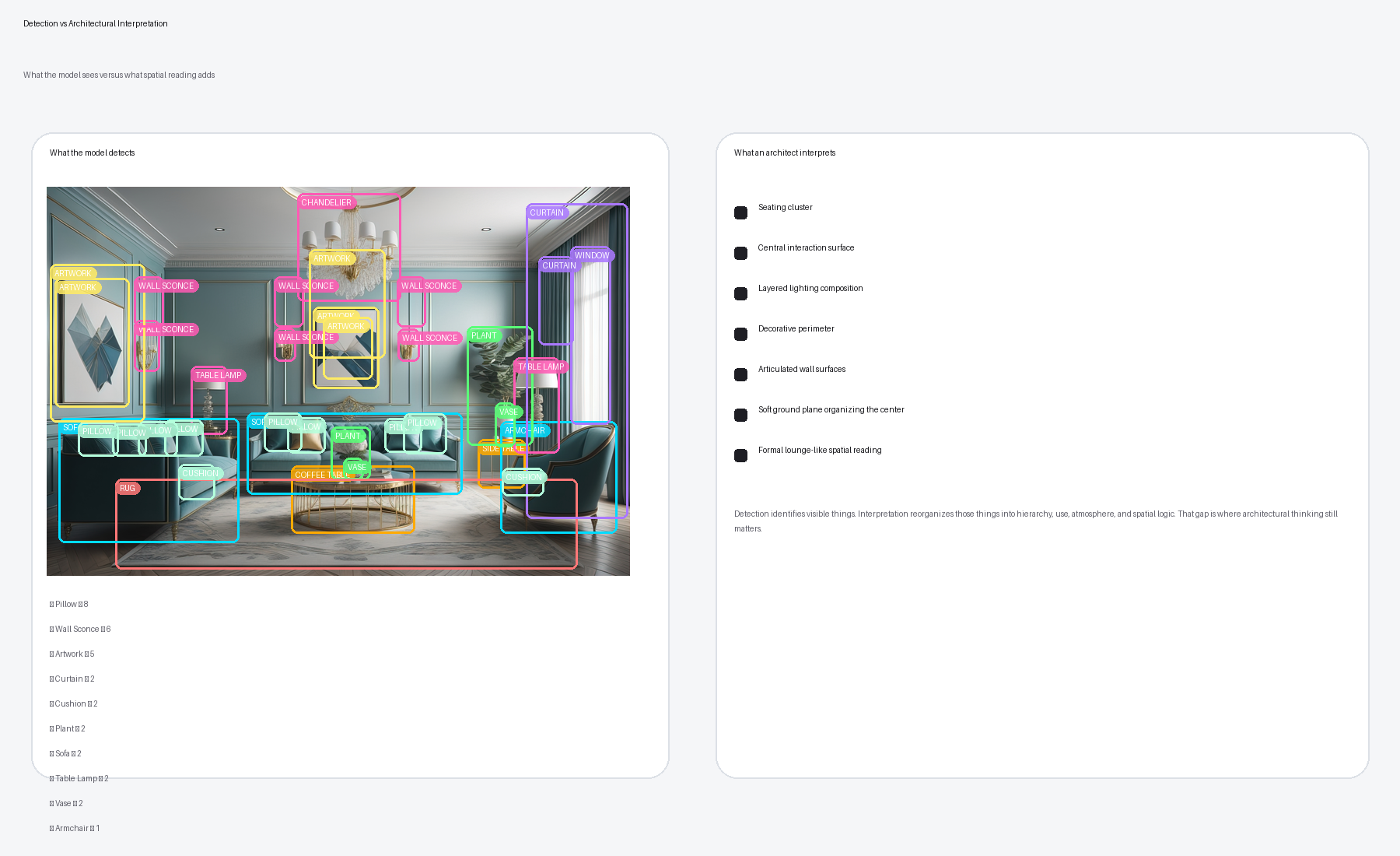
A single sofa reveals very little. A sofa accompanied by armchairs and a coffee table suggests something else entirely. The image begins to indicate a social arrangement rather than a collection of furnishings. Add a rug and that arrangement gains a spatial ground. Add layered lighting and the room begins to imply atmosphere, hierarchy, and emphasis. Add articulated wall elements such as artworks or sconces and the perimeter starts to contribute to the reading as much as the occupied centre.
In other words, the image becomes more meaningful once the elements are read in relation to one another.
This is where object detection starts to matter in architectural terms. Not because the system understands the room in any complete sense, but because it makes certain relationships easier to extract.
© Naveen Maria Fleming / ArchitectsWhoCode
How this can be used?
One obvious use is in reading reference images. Instead of only saying a room “looks good,” object detection helps break down what is actually there. How much seating is present?. Is the room centred around one main surface? Is the lighting doing most of the visual work? It gives a more practical way to read a precedent.
It is also useful for comparing interiors. Two rooms may feel similar, but their layouts can be very different. One might be organised around a central cluster, while another may push everything toward the edges. Once objects are detected and grouped, those differences become easier to describe.
There is also a simple documentation use. Interior photos are usually stored as visual records, but not as structured information. Detection can help turn a room image into a rough inventory of visible elements. It will not replace proper survey work, but it can help with a first reading of what is present.
Another use is basic room inference. A space with several seating elements, a central table, layered lighting, and a rug will usually suggest a lounge or living area. A room built around a desk and one chair suggests something else. The result is still approximate, but it shows how visible objects can start to hint at room use.
© Naveen Maria Fleming / ArchitectsWhoCode
Why this matters computationally?
The useful part, computationally, is that the image stops being just an image.
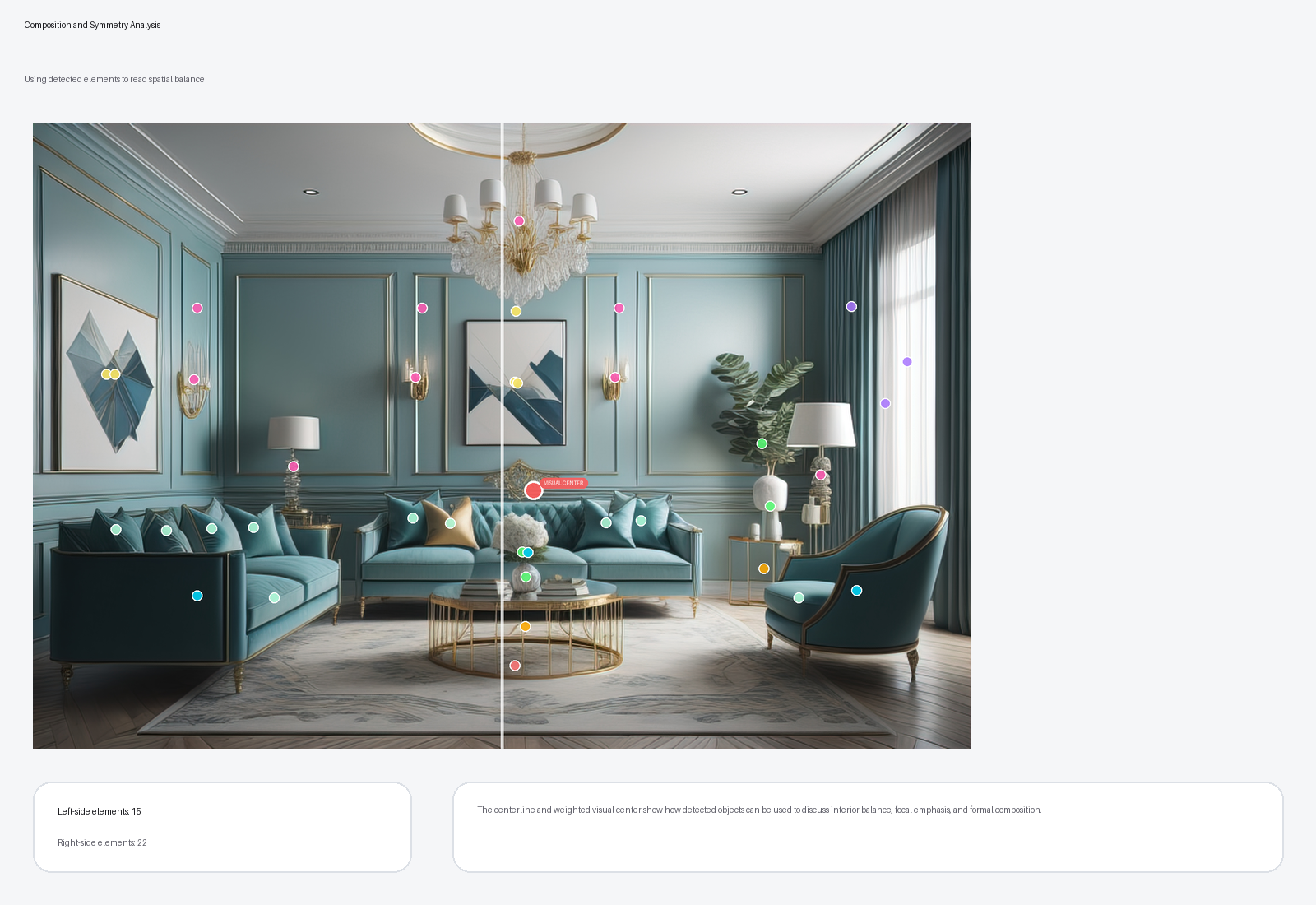
Once visible elements are detected, they can be counted, grouped, and compared. That makes it possible to look at several interiors in a more structured way. You can compare seating density, lighting distribution, the role of central surfaces, or how much of the room is defined by decor and articulation.
Even a simple workflow like this starts turning visual material into something that can be organised and analysed. That is where it becomes relevant beyond just image recognition.

© Naveen Maria Fleming / ArchitectsWhoCode
A necessary distinction
Object detection is not the same as understanding a room.
It can identify objects, but it does not understand atmosphere, comfort, proportion, or intention. It can tell you that a sofa, a rug, and a lamp are present. It cannot fully explain why the room feels balanced or why the arrangement works.
That part still belongs to interpretation.
So the value of object detection is not that it replaces architectural reading. It is that it gives architectural reading a clearer first layer to work from.
Limitations
The limits of this approach are both technical and conceptual.
On the technical side, detection quality depends heavily on the image itself. Highly stylised renders, unusual furnishings, low contrast conditions, decorative complexity, or heavily curated interiors can all make recognition less reliable. Small objects may be overlooked, while visually ambiguous elements may be misclassified or missed altogether.
On the conceptual side, interiors cannot be reduced to the objects they contain. Much of what matters architecturally lies beyond discrete recognition. Proportion, material depth, light quality, sequence, tactility, and lived use are not easily captured through bounding boxes. Even when object detection performs well, it produces only a partial reading.
There is also the issue of inference. Once detections are grouped, it becomes tempting to draw spatial conclusions from them. Some of these conclusions are reasonable, but they remain interpretations rather than certainties. A room may suggest gathering, but that does not mean its social logic has truly been understood.
For that reason, object detection is most useful when treated as a first layer of analysis rather than a complete one.
Conclusion
Object detection does not understand an interior space in the way a designer does. Its value lies elsewhere.
By identifying visible elements and organising them into a clearer structure, it makes an image easier to read, compare, and analyse. In that sense, it does not replace architectural judgment, but supports it by providing a more explicit starting point for interpretation.
References
Szeliski, Richard. Computer Vision: Algorithms and Applications. Springer, 2022.
Goodfellow, Ian, Yoshua Bengio, and Aaron Courville. Deep Learning. MIT Press, 2016.
Redmon, Joseph, Santosh Divvala, Ross Girshick, and Ali Farhadi. “You Only Look Once: Unified, Real-Time Object Detection.” 2016.
Liu, Wei, Dragomir Anguelov, Dumitru Erhan, Christian Szegedy, Scott Reed, Cheng-Yang Fu, and Alexander C. Berg. “SSD: Single Shot MultiBox Detector.” 2016.
Oxman, Rivka, and Robert Oxman, eds. Theories of the Digital in Architecture. Routledge, 2014.