Artificial Intelligence is entering architecture in many different forms. Some tools generate images. Some read documents. Some predict project risks. Some understand building layouts. Some help search through regulations or BIM data.
This is why AI in AEC can feel confusing at first. The term “AI” is often used as if it means one single thing, but in reality, different AI models solve different types of problems.
For architects, designers, engineers, and construction professionals, the most useful starting point is not learning every algorithm in detail. It is understanding what kind of model is used for what kind of task.
This article gives a simple map of the main AI/ML model types used in the AEC industry and where they can be applied.
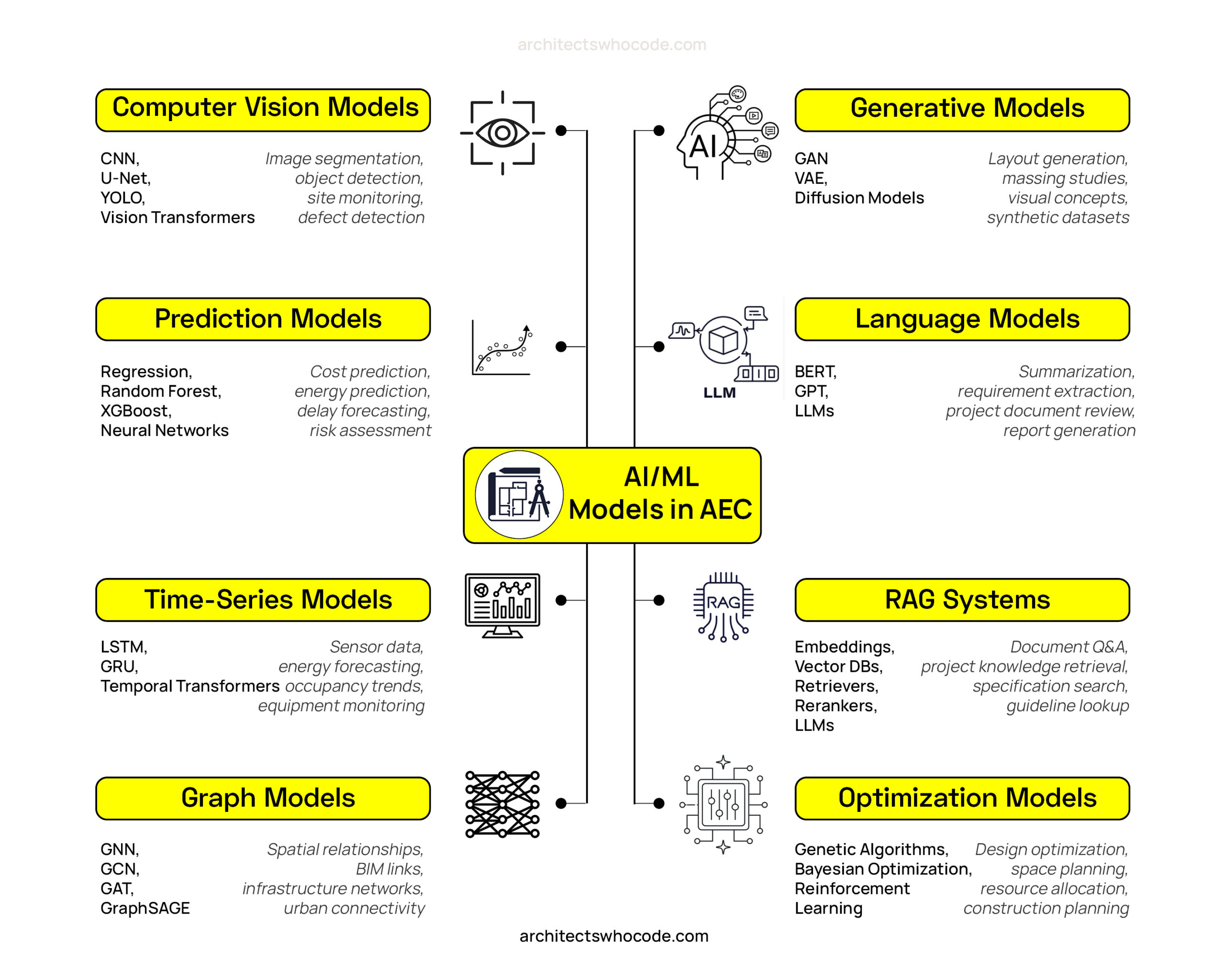
© Naveen Maria Fleming / ArchitectsWhoCode
1. Computer Vision Models
Computer vision models help machines understand visual information.
In AEC, this can mean drawings, site photos, drone images, façade images, scans, or construction videos. These models are useful whenever the input is visual and the task involves identifying, classifying, or detecting something.
Some common computer vision models include CNN, U-Net, YOLO, and Vision Transformers.
In architecture and construction, computer vision can be used for image segmentation, object detection, site monitoring, and defect detection. For example, a model can detect cracks on a surface, identify construction equipment, monitor site progress, or recognize objects in an image.
For architects, this matters because a large part of design and construction is visual. Drawings, images, renders, and site conditions all contain useful information. Computer vision helps convert that visual information into data that can be analyzed.
Typical uses:
- Detecting defects on-site
- Monitoring construction progress
- Reading visual information from drawings or photos
- Identifying materials, objects, or building elements
- Analyzing drone or satellite images
2. Prediction Models
Prediction models are used to estimate what may happen based on existing data.
In AEC, they can support cost prediction, energy prediction, delay forecasting, and risk assessment. These models look at past patterns and use them to make informed estimates for future situations.
Common examples include regression models, Random Forest, XGBoost, and neural networks.
A simple example would be predicting construction cost based on building area, location, material type, and project complexity. Another example could be predicting energy consumption based on climate, building use, and design parameters.
Prediction models are useful because many AEC decisions happen early, when there is uncertainty. A good prediction model can help teams compare options, understand risks, and make better decisions before problems become expensive.
Typical uses:
- Cost estimation
- Energy performance prediction
- Construction delay forecasting
- Risk assessment
- Maintenance planning
3. Time-Series Models
Time-series models are used for data that changes over time.
Buildings and cities constantly produce time-based data. Energy usage changes throughout the day. Occupancy changes by hour. Sensors record temperature, humidity, air quality, and equipment performance. Construction sites also generate time-based progress and monitoring data.
Models such as LSTM, GRU, and Temporal Transformers are often used for this type of problem.
In AEC, time-series models can help forecast future energy demand, detect unusual equipment behavior, or understand occupancy trends. For example, if a building’s energy use suddenly changes from its normal pattern, a time-series model can help detect that something may be wrong.
Typical uses:
- Energy forecasting
- Occupancy trend analysis
- Sensor data analysis
- Equipment monitoring
- Building performance tracking
These models are especially useful for smart buildings, digital twins, and facility management.
4. Graph Models
Graph models are very relevant to architecture because buildings are made of relationships.
A room is connected to a door. A door connects two spaces. A stair connects floors. A wall may separate rooms. A road connects to a street network. These relationships are often as important as the objects themselves.
Graph models represent this kind of information using nodes and connections. A node can be a room, wall, door, stair, building, road, or infrastructure element. A connection can represent adjacency, access, distance, dependency, or flow.
Common graph models include GNN, GCN, GAT, and GraphSAGE.
In AEC, graph models can be used to understand spatial relationships, BIM links, infrastructure networks, and urban connectivity. They are also useful for compliance checking, circulation analysis, and escape route analysis.
Typical uses:
- Spatial relationship analysis
- BIM connectivity mapping
- Urban network analysis
- Infrastructure systems analysis
For architects, graph models are powerful because they do not only look at objects. They look at how objects are connected.
5. Generative Models
Generative models create new content.
In architecture, this can include layouts, massing options, façade ideas, visual concepts, and design variations. These models are often used during early design exploration, when the goal is to test many possibilities quickly.
Common generative models include GAN, VAE, and diffusion models.
A generative model can help create concept images, produce alternative layouts, or generate synthetic data for training other AI systems. This does not mean the model understands architecture in the same way a designer does. It means it can produce options based on patterns it has learned.
For architects, generative models are useful as idea engines.
Typical uses:
- Layout generation
- Massing studies
- Concept visualization
- Façade exploration
- Synthetic dataset creation
6. Language Models
Language models work with text.
AEC projects produce a huge amount of written information: reports, codes, standards, specifications, meeting notes, contracts, design briefs, and technical documents. Language models can help read, summarize, extract, and generate text from these sources.
Common examples include BERT, GPT, and other large language models.
In architecture and construction, language models can be used to summarize long reports, extract requirements from regulations, generate project documentation, review specifications, or support technical writing.
Typical uses:
- Summarizing project documents
- Extracting requirements from codes and standards
- Reviewing specifications
- Drafting reports
- Generating meeting summaries
This is one of the easiest entry points for AI in AEC because most professionals already work with documents every day.
7. RAG Systems
RAG systems connect AI with specific knowledge sources.
RAG stands for Retrieval-Augmented Generation. In simple terms, it allows an AI system to search through documents before answering. Instead of relying only on the model’s general knowledge, it retrieves information from selected sources such as project files, standards, manuals, guidelines, or internal databases.
A RAG system usually includes embeddings, vector databases, retrievers, rerankers, and language models. But the basic idea is simple: search first, answer second.
This is very useful in AEC because project knowledge is often scattered across PDFs, BIM exports, specifications, reports, and regulations.
Typical uses:
- Project document Q&A
- Searching technical standards
- Finding specification clauses
- Retrieving design guidelines
- Supporting compliance workflows
For example, a RAG system could help a team ask questions about a fire safety code, a project manual, or a BIM-related document and receive answers based on the actual source material.
8. Optimization Models
Optimization models help find better solutions under constraints.
Architecture and construction involve many constraints: cost, area, sunlight, structure, circulation, energy use, material limits, regulations, and construction time. Optimization models help search through many possible options and identify better-performing solutions.
Common approaches include Genetic Algorithms, Bayesian Optimization, and Reinforcement Learning.
In AEC, optimization can support space planning, design option testing, construction scheduling, resource allocation, and performance-based design.
Typical uses:
- Space planning
- Design optimization
- Resource allocation
- Construction planning
- Performance-based decision-making
For example, an optimization model could help arrange spaces to reduce travel distance, improve daylight, or balance cost and performance.
How to Choose the Right AI Model
A simple way to understand AI in AEC is to start with the type of input and the type of task.
When the input is an image, drawing, photo, or video, computer vision is usually relevant.
When the goal is to estimate future values, prediction models are useful.
When the data changes over time, time-series models are suitable.
When the problem is about connections between spaces, elements, or networks, graph models are important.
When the goal is to create design options, generative models are useful.
When the input is text, language models are relevant.
When answers need to come from specific project documents, RAG systems are useful.
When the goal is to find the best option among many possibilities, optimization models are suitable.
This basic understanding helps architects and AEC professionals avoid using AI as a vague buzzword. It also helps teams communicate better with developers, researchers, and software companies.
Where AEC Is Heading
The future of AI in AEC will not depend on one model type alone. The most useful tools will combine multiple models into a workflow.
For example, a compliance-checking tool could use language models to read regulations, RAG systems to retrieve relevant clauses, graph models to understand building relationships, and optimization models to suggest design improvements.
A construction monitoring tool could combine computer vision, time-series data, and prediction models to track progress and identify delays.
A design assistant could combine generative models, optimization, and BIM data to create and evaluate design options.
The real value of AI in AEC will come from connecting these models to actual architectural problems.
Final Thoughts
AI in architecture is not only about image generation or automation. It is a broader set of tools that can help professionals see patterns, read information faster, understand relationships, predict outcomes, and explore design possibilities.
For beginners, the key is to understand the role of each model type:
Computer vision helps with visual data.
Prediction models estimate future outcomes.
Time-series models understand change over time.
Graph models understand relationships.
Generative models create new options.
Language models work with text.
RAG systems connect AI to project knowledge.
Optimization models search for better solutions.
Once these categories are clear, AI becomes much easier to understand and apply in AEC.
The goal is not to replace architects, engineers, or construction professionals. The goal is to give them better tools for working with increasingly complex buildings, cities, documents, and data.